

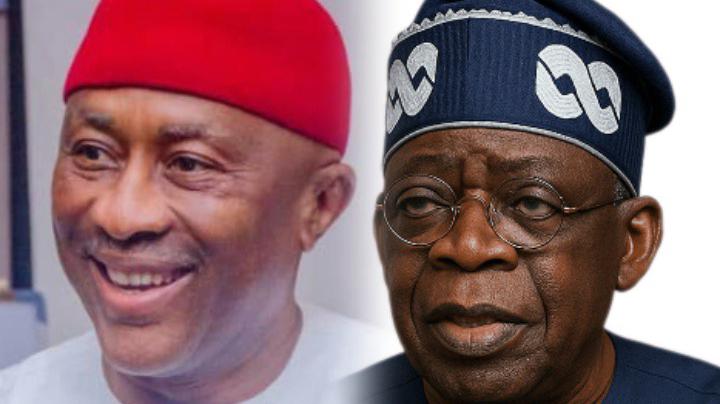
Former member of the House of Representatives, Uche Onyeagocha, has weighed in on the evolution of political parties and the shifting alignments of key political actors ahead of the 2027 general elections, describing party migration and coalition-building as enduring features of Nigeria’s democratic experience.
Onyeagocha made the remarks during a live interview from 21:42 on Symfoni TV, where he reflected on party history, political restructuring, and the changing nature of alliances in Nigeria’s Fourth Republic. His comments come amid renewed discussions over opposition coalitions, political realignments, and the strategic repositioning of major actors ahead of the next election cycle.
In the course of the interview, Onyeagocha specifically referenced the political trajectory of President Bola Ahmed Tinubu, using it as an example of how political figures in Nigeria have historically moved across different party platforms in response to changing alliances and electoral realities.
He noted that Tinubu’s political path has spanned several party formations over the years, beginning with the Alliance for Democracy (AD), progressing through the Action Congress (AC) and later the Action Congress of Nigeria (ACN), before culminating in the formation and consolidation of the All Progressives Congress (APC). According to Onyeagocha, this progression reflects a broader pattern in Nigerian politics, where party mergers and strategic transitions have played a central role in shaping the country’s electoral landscape.
His remarks underscored the argument that party movements and political restructuring are not unusual in Nigeria’s democratic process. Rather, he suggested that they have become defining characteristics of the system, particularly as politicians respond to shifting political realities, emerging alliances, and the demands of electoral competition.
Onyeagocha further argued that these transitions reveal the fluid nature of party ideology in Nigeria, where coalition-building and strategic positioning often take precedence over rigid ideological loyalty. In his view, this flexibility has become one of the most recognizable features of the country’s party system, with many politicians aligning themselves based on political opportunity, relevance, and electoral viability.
He also stressed that as the 2027 general elections approach, public attention should not be focused solely on the history of party affiliations or political migration, but more importantly on the performance of those who occupy public office. He maintained that while party evolution is a legitimate part of democratic politics, the more pressing concern for citizens should be governance outcomes and the quality of leadership being offered…Read_More…