

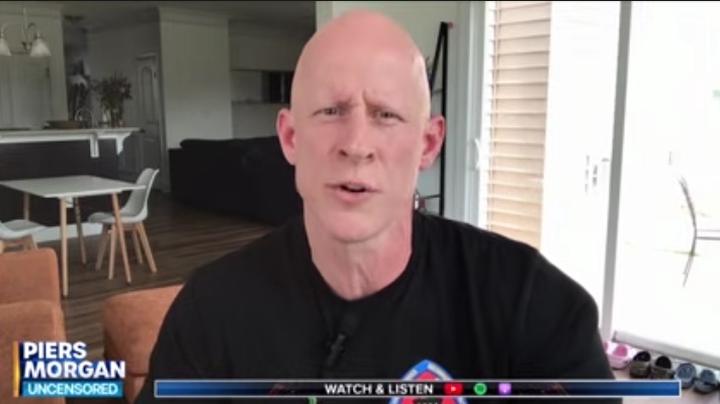
Brian McInness, a United States Marine Corps veteran turned anti-war activist and Green Party Senate candidate, delivered a forceful condemnation of American military involvement in the conflict with Iran on Piers Morgan Uncensored, saying he remained deeply troubled by the human and financial cost being borne by ordinary Americans in what he characterised as a war fought on behalf of a foreign power.
In the recent video from 18:54, “No one wants to fight for Israel,” McInness said, words he had shouted from the public gallery of a Senate hearing before being forcibly removed — an incident in which he says his arm was broken in a door. “I still feel very concerned about what we’re committing American troops to the cause we are.”
McInness told Morgan that his protest was rooted in a conviction that the war against Iran was not being waged in the genuine national security interests of the United States. He argued that American bases in the region were being struck by Iranian missiles, with thirteen Americans killed so far, while the financial cost was running at two billion dollars a day, adding to the national debt. He cited the resignation of Joe Kent, the former national counter-intelligence director, as evidence that the case for war lacked legitimacy, noting that Kent had specifically stated Iran posed no imminent threat and that Israeli lobby influence had driven the decision to attack.
Morgan acknowledged that Secretary of State Marco Rubio’s early public explanation for the strikes had pointed, at least implicitly, toward Israeli pressure. Rubio had suggested that because another country — widely understood to mean Israel — was preparing to attack Iran, which would in turn provoke Iranian retaliation against American assets, the United States had acted pre-emptively. Morgan described that justification as “incredibly convoluted,” and noted it had quickly been walked back.
McInness was unsparing in his assessment of what the conflict was ultimately about. He argued that the so-called Greater Israel Project sought to make Israel the dominant power in the Middle East, and that weakening the West was a by-product of that ambition. He contrasted the sacrifices being made by working-class American families — “their sons and daughters, moms and dads” — with what he described as the profits being reaped by an investor class he linked to broader networks of elite financial interest.
His comments drew a pointed rebuttal from Goldie Ghamari, the Iranian-Canadian activist and former Canadian MP, who accused McInness of repeating Islamic regime propaganda and challenged him to account for the tens of thousands of Iranian protesters killed by their own government. Morgan himself pushed back, arguing that while Israeli influence on the decision was plausible, ultimate responsibility for American involvement rested with the United States and its president.
McInness did not retreat from his position, and closed by expressing hope that Trump’s diplomatic efforts would succeed in de-escalating the conflict — while making clear he believed the war should never have been started. Read_More…